Supportive IV care is often discussed as a way to improve energy, recovery, or overall wellness. Because it delivers fluids and nutrients directly into the bloodstream, it can feel like a straightforward intervention.
But supportive IV care is not universally appropriate. Its value depends on timing, context, and the pattern behind the symptoms.
Understanding when it makes sense, and when it does not, helps reduce both overuse and missed opportunity.
Clarity protects outcomes. Misaligned timing often explains why some people feel significant benefit while others notice little change.
For readers exploring the broader role of IV therapy in energy support, our article on IV therapy for energy and recovery provides helpful clinical context.
The answer depends less on the treatment itself and more on timing, physiology, and underlying demand.
In short, supportive IV care tends to make sense during short term physiological strain and less so during long standing systemic imbalance.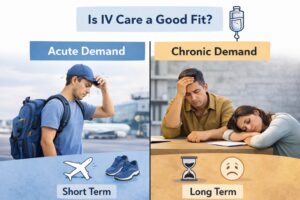
The Difference Between Acute and Chronic Demand
The body responds differently to short term strain than to long term imbalance.
Acute demand may include:
Travel fatigue
Temporary dehydration
Illness recovery
High intensity activity
Short periods of elevated stress
In these situations, systems are usually functioning well but temporarily stretched. Hydration and nutrient support may help restore equilibrium more quickly.
Chronic demand is different.
It may include:
Persistent sleep disruption
Ongoing psychological stress
Long term workload imbalance
Repeated overtraining
Months of unresolved fatigue
In these cases, the body has adapted to sustained pressure. Supportive IV care alone may not address the underlying pattern.
Recognizing which category applies is essential.
Institutions such as the Mayo Clinic overview on fatigue causes emphasize how persistent symptoms often reflect layered influences rather than isolated deficiency.
When Supportive IV Care Aligns With Physiology
Supportive IV care often makes sense when energy decline is recent and situational.
It may be appropriate when:
Energy decline is recent and situational
Recovery has been temporarily impaired
Hydration has clearly been compromised
Nutrient intake has been inconsistent
The body is facing a defined, short term demand
In these contexts, the goal is stabilization, not transformation.
Providing hydration and selected nutrients through IV therapy in Boulder may help reduce strain on systems that are temporarily overloaded.
Because the stressor is limited, the response may feel noticeable.
For individuals also considering metabolic support approaches, NAD support therapy may be integrated thoughtfully within defined periods of increased demand.
When It May Not Be the Right First Step
There are also situations where supportive IV care may not be the most effective starting point.
If fatigue has persisted for many months
If sleep quality remains consistently poor
If stress levels remain chronically elevated
If energy fluctuates regardless of rest or hydration
Then deeper evaluation may be more useful than immediate infusion.
Repeated intervention without understanding the driver can create a cycle of temporary improvement followed by return of symptoms.
This does not mean supportive IV care has no place. It means timing matters.
Our discussion on IV therapy for fatigue explores this distinction in more detail.
The Role of Expectation
Expectation influences perception.
If supportive IV care is approached as a reset button, disappointment is likely.
If it is approached as targeted support within a broader framework, outcomes tend to align more closely with physiology.
Supportive IV care is not designed to override lifestyle patterns. It is designed to assist the body during periods of strain.
Understanding this distinction shifts the goal from chasing rapid change to restoring balance.
The National Institutes of Health discussion on stress and systemic regulation highlights how chronic stress patterns influence energy systems beyond hydration alone.
Individual Variability Matters
Two people can experience similar symptoms and respond differently to the same intervention.
Factors that influence response include:
Baseline hydration
Sleep consistency
Stress load
Activity level
Nutrient status
Metabolic variation
Without considering these variables, it is difficult to predict outcome.
Supportive care works best when individualized rather than standardized.
For individuals considering supportive IV care in Boulder, personalization often determines whether the experience feels meaningful or minimal.
A personalized supportive consultation can help determine whether hydration, nutrient support, or broader lifestyle factors deserve priority.
Support Versus Substitution
One of the most important distinctions in wellness care is the difference between support and substitution.
Support assists systems that are already functioning but temporarily strained.
Substitution attempts to replace habits that have not been maintained.
Supportive IV care fits into the first category. It is not a substitute for sleep, balanced nutrition, stress regulation, or sustainable workload.
When this boundary is respected, IV care remains a useful tool rather than an overextended solution.
Integrating IV Care Into a Broader Plan
For some individuals, supportive IV care becomes part of a structured approach.
This may include:
Periodic hydration during high demand periods
Occasional nutrient support when intake has been inconsistent
Protocols that are adjusted based on life changes
The goal is not constant infusion. It is strategic application.
When integrated into a broader plan, IV care supports resilience rather than replacing responsibility.
If you have questions about whether this approach aligns with your current needs, you are welcome to contact our clinical team for further clarification.
A Practical Framework for Decision Making
Before pursuing supportive IV care, it can be helpful to ask:
Is the fatigue recent or long standing
Has hydration clearly been compromised
Are sleep and recovery patterns stable
Is stress load manageable
Is this a temporary strain or a chronic pattern
These questions do not require perfection. They require honesty.
Answering them helps determine whether supportive IV care aligns with current needs.
A Thoughtful Path Forward
Supportive IV care can be meaningful when it matches context. It can be unnecessary when used without evaluation.
The goal is not to increase intervention. It is to improve alignment.
When used intentionally, IV therapy may help stabilize energy and recovery during periods of defined strain.
When fatigue reflects deeper patterns, a structured clinical conversation may provide greater clarity than repeated sessions.
Wellness support works best when it respects timing, capacity, and individual variability.